It was mid-February. Amazon dropped an update on Seller Central forums. The title looked routine — just a Business Solutions Agreement revision. Most sellers scrolled past it. A few read it but couldn't quite work out what it meant for their operations.
On March 4, 2026, that update went live. And from that moment, every automated tool connected to an Amazon seller account entered a new legal framework.
It's called the Agent Policy.
Why does this affect you?
Do you use a repricing tool? Do you manage your PPC through a third-party platform? Do you have software handling your inventory, your feeds, or your reporting?
All of it now falls under the definition of an “Agent.”
Amazon has formalised this category for the first time. Any system that accesses your account automatically through SP-API or the Amazon Ads API is in scope. That includes a simple repricing bot and a large-scale integration platform alike.
What has actually changed?
Three obligations now apply and none of them are open to interpretation.
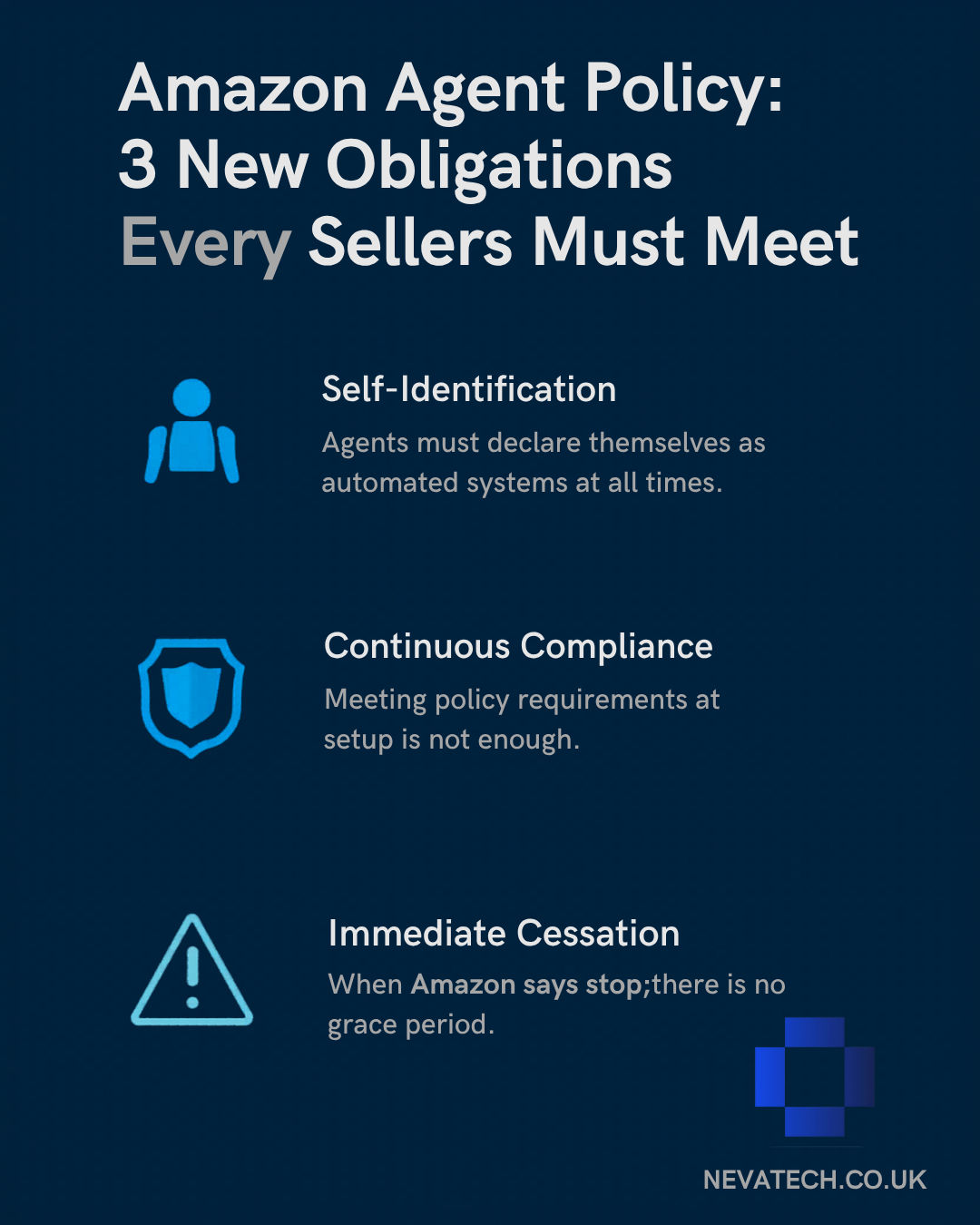
- 1Every agent must identify itself as an automated system when interacting with Amazon. Tools that operate in the background while appearing to behave like a human user are now in direct violation of policy.
- 2Compliance must be continuous. Being compliant at the point of setup is not enough. The system must meet policy requirements at every moment it is running.
- 3When Amazon says stop, the tool must stop. Immediately. There is no appeals process and there is no grace period. Access is terminated on the spot.
There is one more requirement worth noting. Every automated action must be traceable to a registered developer account. Any tool operating without a valid SP-API application ID is treated as unauthorised access, regardless of its technical behaviour.
"But I didn't build the tool."
This is one of the most common responses to this policy. And unfortunately, it does not hold up.
The responsibility sits with the seller using the tool, not the company that built it. Knowing whether your software is compliant is your obligation. You can ask your provider for a written compliance statement. A serious provider should be able to give you one. If they cannot, they have already given you their answer.
When does the transition window close?
The transition period began on March 4 and ends in June 2026. After that date, Amazon will enforce without prior warning.
Three steps, and none of them are complicated.
- 1List every third-party tool connected to your Amazon account — repricing, PPC, inventory, feeds, reporting, everything.
- 2Check which of those tools access Amazon through SP-API or the Amazon Ads API.
- 3Request written confirmation of Agent Policy compliance from each provider.
If you have not done this yet, June will arrive before you are ready.
Where does this leave you?
The Agent Policy makes one thing clear. Knowing what is connected to your Amazon account, what data those tools access, and whether your providers are genuinely compliant is no longer optional.
A good starting point is pulling together your own tool list and asking your providers directly. If you would like a more thorough review, we are happy to talk it through.