
Imagine you run a restaurant. You know exactly what's in the kitchen, which table ordered what, and how much cash is in the till at the end of the night. Then one day a software company comes along and says: “Give us access and we'll manage everything for you automatically.” So you do.
But if that software company can now walk into your kitchen, open your till, and browse your customer list whenever they want, how much control do you actually have left?
That's the easiest way to understand what's happening on Amazon.
If the door is open, someone can walk through it
Amazon built a system that lets sellers connect their accounts to third-party software. That system is called SP-API, short for Selling Partner API. It's a technical name for a simple idea: a door that Amazon opened to the outside world.
Through that door, the inventory tool you use, your repricing software, your advertising platform can all connect to your account. They get notified when an order comes in. They update your prices. They send alerts when stock runs low.
That sounds useful. Because it is. But if the door is open, what's inside becomes visible.
What goes through that door?
When you give a piece of software access through SP-API, you're giving it access to the core of your business:
- Your full order history
- Your inventory data
- Your pricing information
- The ability to manage your listings
- Your financial reports
- Your customer messages
- Your advertising data
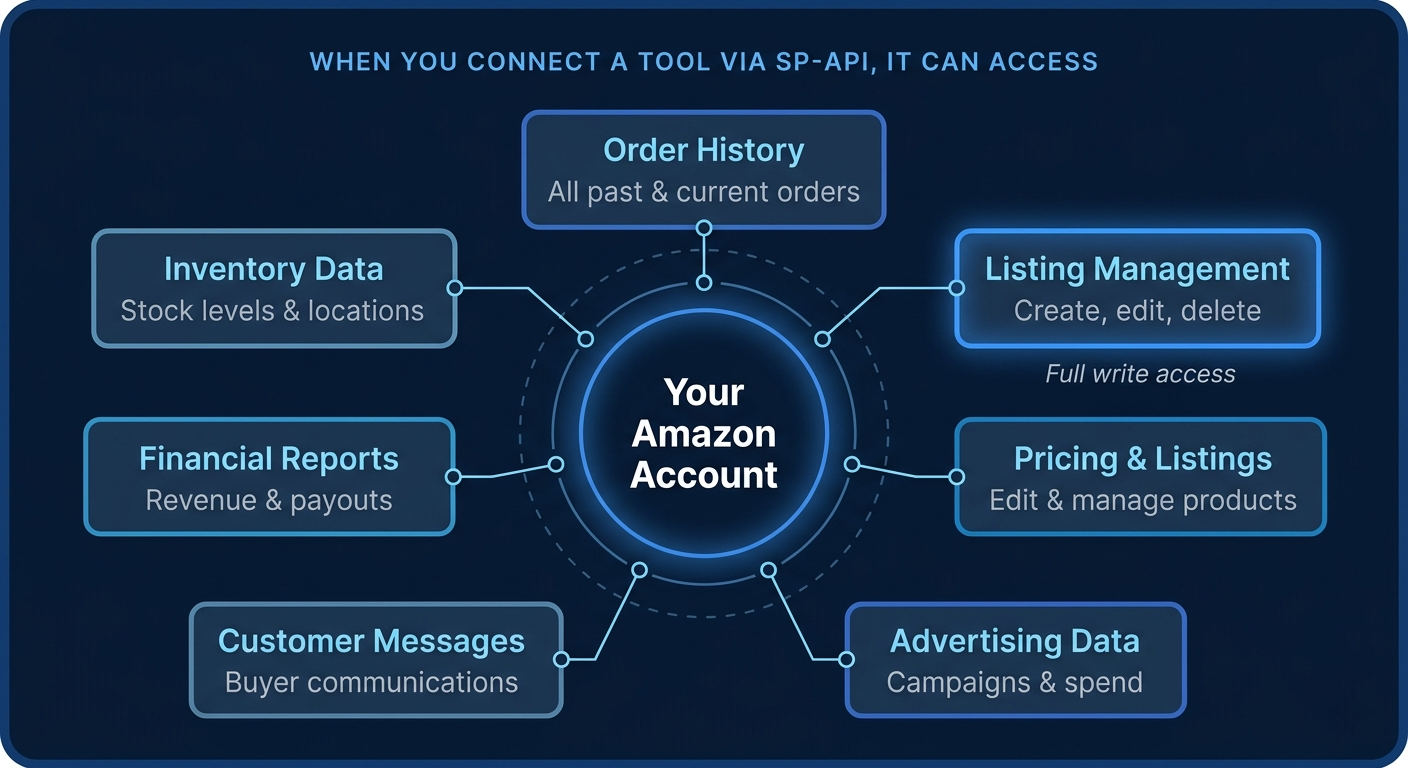
Think about that for a moment. This isn't just technical data. It's your entire business.
Who bought what, how much you earned, which products are performing, what your customers are saying to you. And all of it, without you necessarily realising, could be accessible to dozens of different tools at the same time.
"But I only use trusted tools"
We hear this a lot. And often it's true. The tool itself might be completely legitimate. But security isn't just about intentions. It's about structure.
Think of it this way: you gave your house key to a friend you trust completely. But that friend carries it loose in their bag, never locks the bag, and sometimes leaves it on a café table. Your friend isn't being malicious. But is the key safe?
SP-API access works the same way. Even if the tool is trustworthy, if it's been granted more access than it actually needs, that's a problem. If it isn't subject to regular security audits, that's a problem. If it isn't compliant with Amazon's latest policies, that's a problem. And if you're not aware of any of this, that's the biggest problem of all.
What if Amazon decides to close the door?
As we covered in last week's article, Amazon made a significant change to its SP-API policy in March 2026. Every piece of software using the API is now classified as an “Agent” — something acting on Amazon's behalf.
We went into detail on what that means in practice last week. But here's the short version: Amazon is now watching far more closely who uses this door and how. Accounts found to be non-compliant can face serious consequences, from warnings all the way to suspension.
Most sellers don't know this
That's not a criticism. It's an observation. SP-API is a technical topic and Amazon doesn't explain it to sellers in plain language. It shows up as an update in Seller Central and most people close it without reading.
But this directly affects the security of your account. Where your data is going. And whether one day Amazon might knock on your door and tell you that one of your tools doesn't meet their requirements.
What should you do?
Before taking any big steps, ask yourself these three questions:
- 1Which tools are connected to my account through SP-API? Do you know all of them, including old integrations you may have forgotten about?
- 2What kind of data do they have access to? Just inventory, or financial reports and customer data too?
- 3Are they compliant with Amazon's current policies? Have you received written confirmation from your providers?
If you don't know the answers, that's exactly where an SP-API audit begins.
SP-API isn't complicated and it isn't something to be afraid of. But left unexamined, it quietly builds risk.
Knowing which tools are connected to your account, understanding what data they touch, and confirming they're aligned with Amazon's policies are not technical questions. They're strategic ones.